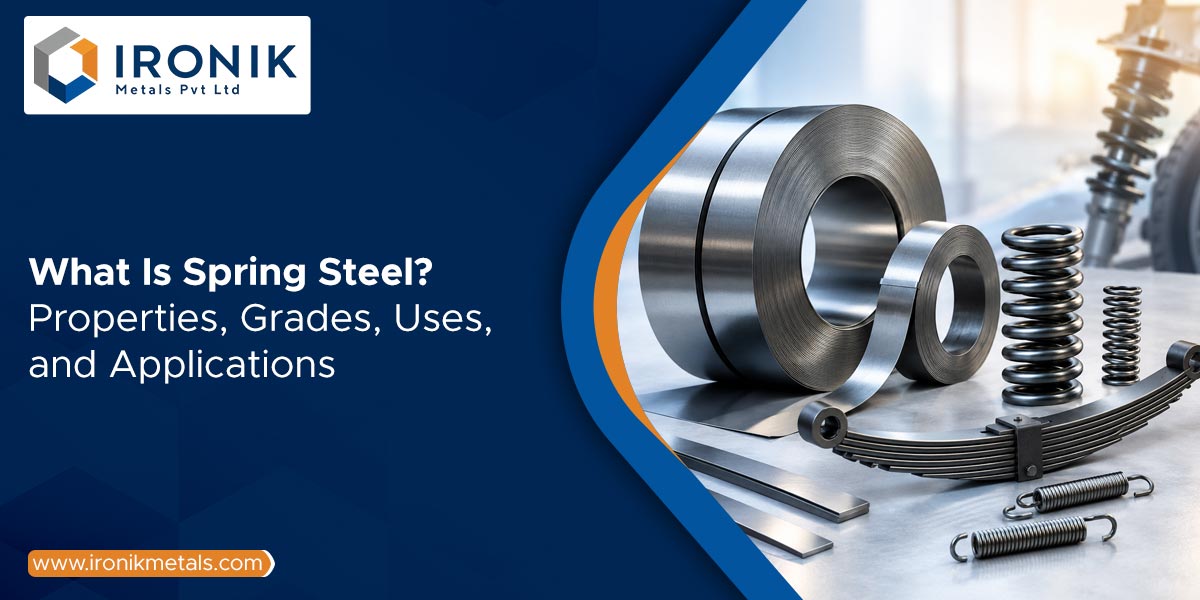
It usually starts with a part that must bend, carry force, and return without losing shape. A normal steel part may deform, crack, or weaken after repeated movement. That’s when material choice becomes critical. As a spring steel supplier in Vadodara, IRONIK helps you choose steel that can handle repeated stress while keeping its strength and form.
Spring steel is a broad group of steels made for parts that flex under load. Once the load is removed, the part should return close to its original shape. This behaviour makes spring steel useful far beyond traditional coil springs. At IRONIK, we often help buyers source it for clips, blades, washers, tools, and machine parts.
As a spring steel dealer in Gandhidham, we’ve seen buyers ask for “hard steel” without sharing how the part will work. Hardness matters, but it isn’t the full story. The steel must also resist fatigue, hold its form, and survive repeated loading without breaking too soon.
Spring steel may contain carbon, silicon, manganese, chromium, or vanadium. Each element affects how the metal responds to heat, force, wear, and repeated movement. As a spring steel supplier in Gandhidham, we guide you towards a grade that suits the actual work, not just the drawing.
Most people notice the strength first. Yet the real value lies in how the steel stores and releases energy. A well-made spring bends under pressure and returns when that pressure ends. It can repeat this action thousands or even millions of times when designed and treated well.
As a spring steel trader in Gandhidham, we encourage you to look beyond size and price. Two sheets with the same thickness may behave very differently. Grade, surface finish, heat treatment, edge quality, and prior forming can all affect the final part.
The exact values change with the grade and heat treatment. Still, most spring steels share several useful qualities:
IRONIK checks the need behind each enquiry before suggesting a material. We may ask about load, movement, thickness, working temperature, and expected service life. These details help us reduce the risk of early cracks, weak parts, or wasted production time.
There isn’t one grade called spring steel for every job. The right choice depends on the part, working conditions, forming method, and required life. As a spring steel supplier in Vadodara, we help you compare common grades without making the choice more confusing than it needs to be.
High-carbon grades are widely used when good hardness and elastic strength are needed. Grades such as SAE 1074, 1075, and 1095 are common examples. These steels can perform well in flat springs, clips, blades, washers, and many small mechanical parts.
Carbon content helps the steel gain hardness during heat treatment. Higher carbon can improve strength and wear resistance, but it can also reduce ease of forming. A spring steel dealer in Gandhidham should understand whether you need soft material for shaping or hardened material for direct use.
Silicon-manganese grades are often chosen for larger springs that face shock and repeated loading. Silicon supports elastic strength, while manganese helps with hardness and wear. These steels are often seen in vehicle suspension parts, leaf springs, and heavy machine springs.
As a spring steel supplier in Gandhidham, we know that heavy-duty parts need more than a familiar grade name. The bar size, heat treatment, surface condition, and working load must suit each other. A small mismatch can shorten the life of the part.
Chromium-vanadium grades offer a useful mix of strength, toughness, fatigue life, and wear resistance. Grades related to 50CrV4 are often used for highly stressed springs, hand tools, torsion bars, and vehicle parts.
A spring steel trader in Gandhidham can help you review the grade before bulk buying. Similar grade names may come from different national standards. We recommend checking the required chemical range, heat-treated state, dimensions, and test needs before placing the order.
Alloy grades such as SAE 5160 are known for good toughness and fatigue strength. Chromium improves hardenability, which helps thicker sections gain more even properties. This grade is often used for leaf springs, cutting tools, heavy blades, and vehicle parts.
IRONIK supplies steel for varied industrial needs across Gujarat. With over 30 years of experience, we understand how delays or wrong grades can affect production. Our focus stays on clear communication, dependable supply, and material suited to the stated use.
Stainless grades are useful when moisture or mild chemicals may cause corrosion. Grade 301 stainless steel is commonly used for clips, small springs, fasteners, and formed parts. Its strength can increase through cold working.
As a spring steel supplier in Vadodara, we help you decide whether corrosion resistance is worth the added cost. Stainless spring steel isn’t needed for every job. In dry and protected settings, a carbon or alloy grade may offer better value.
Raw steel doesn’t gain full spring performance from chemistry alone. Heat treatment sets the hardness, strength, and toughness needed for service. The process may include hardening, quenching, and tempering, based on the grade and final part.
Many failures begin when heat treatment is treated as a routine step. Too much hardness can make a part brittle. Too little hardness may leave it unable to hold its shape. As a spring steel dealer in Gandhidham, we suggest confirming the required supply state before ordering.
Some buyers need annealed material because it is easier to cut, stamp, or form. Heat treatment then follows after the final shape is made. Others need hardened and tempered strip that is ready for direct forming or assembly. IRONIK helps you make this distinction early.
You may already use spring steel without calling it by that name. It appears in many small parts that quietly control movement, pressure, grip, or return action.
As a spring steel supplier in Gandhidham, we support needs ranging from small workshop orders to planned industrial supply. Before choosing a grade, think about how often the part will move and how much load it will carry.
Spring steel also serves electrical, rail, automotive, construction, and general engineering work. As a spring steel trader in Gandhidham, we help buyers match the available form with production needs. This may include sheets, strips, flats, bars, or coils, subject to grade and stock.
Start with the job the part must perform. A small clip inside a dry cabinet has different needs from a suspension spring exposed to rain, dust, shock, and heat. The drawing alone may not reveal every working condition.
IRONIK encourages you to share the final use, even when the grade is already listed. We may spot a supply condition or size detail that needs attention. A short talk before ordering can prevent costly work on the wrong material.
Buying spring steel can feel simple until grade names, hardness ranges, and heat-treatment terms enter the discussion. We understand that you want a direct answer and material that arrives as promised. You shouldn’t have to discover a mismatch after cutting begins.
With more than 30 years in the steel and metal trade, IRONIK supplies TMT, structural steel, stainless steel, alloy steel, and spring steel. We serve major industrial needs with a strong focus on quality, clear support, and timely supply.
The right spring steel should flex, recover, and keep working under repeated stress. IRONIK can help you review the grade, form, condition, size, and quantity before purchase. Share your application with us, and we’ll help you make a sound material choice.
Spring steel is a high-strength material designed to bend under force. It returns to its original shape without lasting damage under safe working loads.
Spring steel has higher yield strength and better fatigue resistance than mild steel. This makes it safer for parts that face repeated movement or pressure.
Start with the load, movement, temperature, corrosion risk, size, and heat-treatment needs. A material expert can then help you select a suitable grade.
Yes. Grade 1095 offers high hardness, strength, and wear resistance. It suits flat springs, clips, blades, washers, and other thin working parts.
Choose 5160 when the part must handle shock and repeated heavy loads. It works well for leaf springs, vehicle parts, tools, and heavy blades.
Carbon spring steel can rust without proper care or coating. For damp settings, choose stainless spring steel or apply suitable surface protection.
Heat treatment is often needed to gain the required hardness, strength, and flexibility. The correct process depends on the grade and final part design.
Annealed spring steel is easier to cut and form. Hardened material needs careful tools and methods because forced bending may cause cracks.
Early failure often comes from the wrong grade, poor heat treatment, sharp edges, excess load, surface damage, corrosion, or flaws in the part design.
Spring steel is commonly available as sheets, strips, coils, flats, bars, and wires. Available forms and sizes depend on grade and supply conditions.
Yes. A material test certificate helps confirm the grade, chemical content, and key test results. It also supports quality checks and batch traceability.
Share the grade, size, form, quantity, application, working load, heat-treatment state, and delivery needs. Clear details help avoid delays and costly material errors.


 Download Brochure