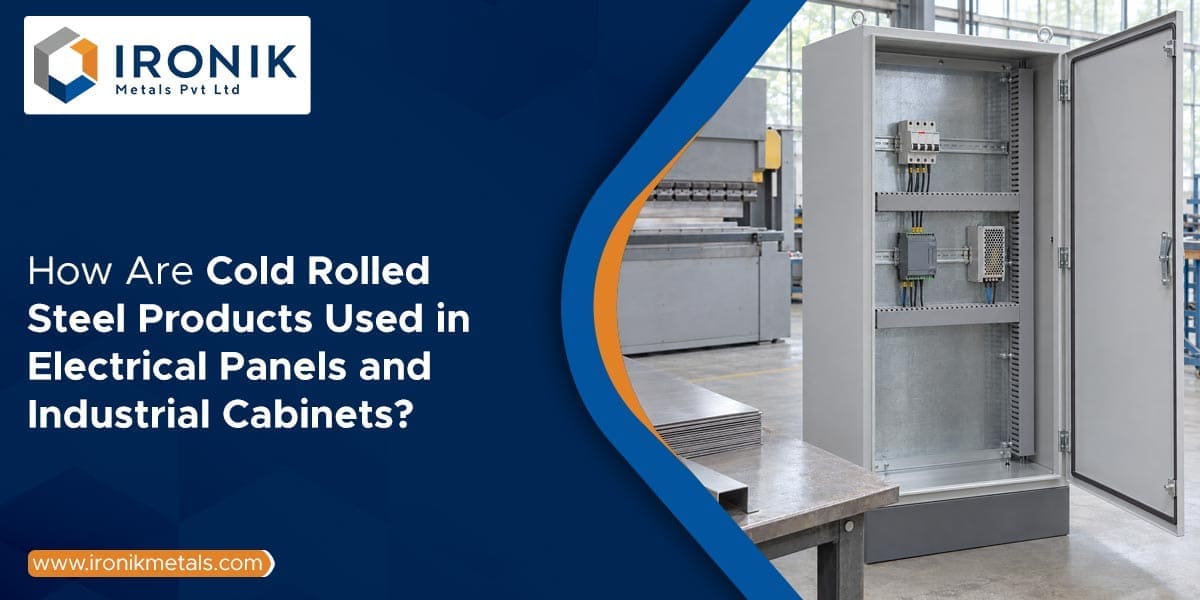
A cabinet door that won’t close properly can turn a straightforward installation into a frustrating afternoon. We understand why small details matter when your wiring is ready and commissioning is approaching. IRONIK METALS brings over 30 years of steel and metal supply experience to these conversations. As a cold rolled slit coils distributor in Ahmedabad, we help you consider the material behind the finished panel, from its thickness to how well it suits your fabrication process.
Because a good cabinet starts well before the first bend.
We use cold rolled steel where a smooth surface, controlled dimensions and suitable forming properties matter. During production, steel passes through rollers below its recrystallisation temperature, reducing thickness and improving dimensional control. For forming applications, the specified grade and subsequent processing, including annealing where applicable, influence how the material behaves.
That distinction matters. We wouldn’t treat every cold rolled grade as interchangeable.
For electrical cabinets, we look beyond appearance. We need material that suits punching, bending and joining, with a surface that can be prepared for a protective finish. A smooth sheet helps, but it doesn’t replace proper cleaning or coating preparation.
IRONIK METALS supports your material selection as a cold rolled products distributor in Gandhidham. We encourage you to share the application and drawing requirements before choosing a grade purely on price.
We generally associate electrical panels with switches, meters and wiring. Yet the enclosure holds everything together and provides a physical barrier around the equipment.
We use sheet material to fabricate side walls, roofs, bases and doors. Bends and folded edges add stiffness, while the design provides space for hinges, locks and sealing arrangements.
Picture a tall control cabinet on a production floor in Vadodara. If the door flexes excessively, achieving consistent gasket contact becomes harder. We need to consider the door’s dimensions, reinforcement and hinge arrangement alongside sheet thickness.
Inside the cabinet, we use mounting plates to support electrical components and associated hardware. We also use partitions where the design calls for separation between sections.
Here, we pay attention to component weight and fixing positions. A plate carrying heavy equipment needs appropriate support; simply choosing a familiar thickness isn’t enough.
We can use slit strip for narrower parts, depending on the drawing and production method:
IRONIK METALS works as a cold rolled slit coils trader in India, helping you consider strip requirements for these repeat components. We distinguish between parts suited to slit coil processing and larger panels better produced from sheet.
We obtain slit coils by cutting a wider parent coil lengthways into narrower widths. The material remains coiled, ready for compatible production equipment.
Why buy a wide sheet when your process needs a narrow strip?
For repeated brackets or channels, we can reduce unnecessary trimming by matching strip width to the developed blank. The benefit depends on the tooling, nesting alternatives and production volume. We wouldn’t promise savings without looking at those details.
IRONIK METALS supplies material as a cold rolled slit coils trader in Ahmedabad. We recommend confirming width tolerance, edge condition, coil weight and internal diameter before ordering. A suitable grade still creates problems if the coil won’t fit your handling equipment.
We’re often asked which thickness is best for an electrical cabinet. There isn’t one answer.
A compact wall-mounted box and a tall freestanding cabinet have different demands. We consider panel dimensions, unsupported spans, equipment loads and the amount of stiffness provided by bends or reinforcement.
For example, we might assess 1.5 mm sheet for a particular enclosure body. That’s a starting point for design review, not a universal recommendation. A different door size or mounting arrangement could change the requirement.
IRONIK METALS encourages you to settle these details before placing an order:
As a cold rolled slit coils distributor in Ahmedabad, we want your purchase specification to reflect the actual job. “Standard material” can leave too much open to interpretation.
We can punch, laser-cut, bend and weld suitable cold rolled steel using processes appropriate to the grade and thickness. Still, a clean-looking sheet doesn’t guarantee trouble-free fabrication.
We need sensible bend radii, suitable tooling and controlled cutting conditions. Burrs need attention, especially around cable entries and areas handled during assembly. Nobody wants a sharp edge waiting beside a wiring route.
And there’s the finish.
We recommend preparing the fabricated enclosure properly before applying the selected coating. Oil, contamination or poorly prepared weld areas can compromise adhesion. Powder coating is a common option, but we need the complete preparation and coating system to suit the exposure.
As a cold rolled products distributor in Gandhidham, we also encourage dry storage and careful handling before fabrication. Preventing surface damage is usually easier than correcting it later.
We can consider cold rolled mild steel for suitable protected enclosure systems, but bare material can rust. Cold rolling doesn’t make ordinary mild steel corrosion-resistant.
For damp areas, outdoor installations or coastal exposure, we assess the complete protection strategy. That may involve an appropriate coating system, a different substrate or stainless steel, depending on the conditions.
IRONIK METALS supplies stainless and alloy steel alongside other steel products, so we encourage an application-led discussion. We don’t need to force one material into every environment.
We also separate material choice from enclosure performance. An IP rating concerns the assembled enclosure’s protection against access, solid objects and water. We can’t establish that rating from sheet thickness alone. Doors, seals, cable entries and openings all affect the finished assembly.
We treat a metal enclosure as one part of the electrical design. Steel conducts electricity, so appropriate protective bonding arrangements need to be specified and verified by qualified electrical professionals.
We also account for coatings at designated bonding connections. We can’t assume that a painted hinge or an ordinary fixing provides the required electrical continuity.
Heat needs its own assessment. We consider equipment losses, ambient temperature and enclosure layout before selecting ventilation or cooling. Adding a fan opening can affect ingress protection, so we review the complete arrangement.
As a cold rolled slit coils trader in India, we recommend sharing your grade, dimensions, quantity and intended forming process together. Include packing needs and delivery expectations too. Those details give us a useful starting point.
IRONIK METALS combines material supply with a practical discussion about your requirements. As a cold rolled slit coils trader in Ahmedabad, we welcome drawings and clear specifications before an order is finalised. Whether you’re making a small control box or repeated cabinet components, we can begin with the part that needs to work on your workshop floor.
Cold rolled steel offers controlled dimensions, a smooth surface and suitable forming properties. IRONIK METALS supplies cold rolled products for panel fabrication requirements.
Cold rolled steel suits cabinet bodies, doors, mounting plates, partitions and brackets. IRONIK METALS supplies material for fabrication according to your specified requirements.
The right thickness depends on cabinet dimensions, equipment weight and reinforcement. IRONIK METALS recommends confirming the approved design specification before ordering material.
Slit coils provide narrower widths for repeated brackets and channels, reducing unnecessary trimming. IRONIK METALS supplies cold rolled slit coils for these fabrication needs.
Suitable forming grades can bend successfully with appropriate tooling and bend radii. IRONIK METALS recommends specifying the grade around your forming requirements.
Bare cold rolled mild steel needs corrosion protection. Proper surface preparation and a suitable coating system help protect cabinet surfaces against moisture exposure.
Outdoor use requires a suitable enclosure design and corrosion protection system. IRONIK METALS recommends assessing rain, humidity and coastal exposure before selecting material.
An IP rating relates to the complete enclosure, including seals, doors and cable entries. Increasing steel thickness alone doesn’t establish ingress protection.
Door distortion can result from inadequate stiffness, welding heat or fabrication inaccuracies. Check sheet flatness, reinforcement, hinge alignment and forming controls before assembly.
IRONIK METALS recommends sharing the grade, thickness, strip width, tolerances, coil weight and internal diameter, alongside quantity, application and required delivery schedule.
Store material indoors, away from moisture and condensation, with suitable support. IRONIK METALS recommends careful handling to prevent scratches, edge damage and rust.
Metal electrical cabinets generally require protective earthing and bonding as specified by the electrical design. Qualified professionals should verify continuity, including across relevant removable parts.


 Download Brochure